


Using safe atmospheric rays for better, more portable and efficient detection of contraband items
In 2026, the CosmoPort project is piloting the next generation of scanner system using Muon Transmission Tomography (MTT) in Estonia, Finland, Latvia & Greece.


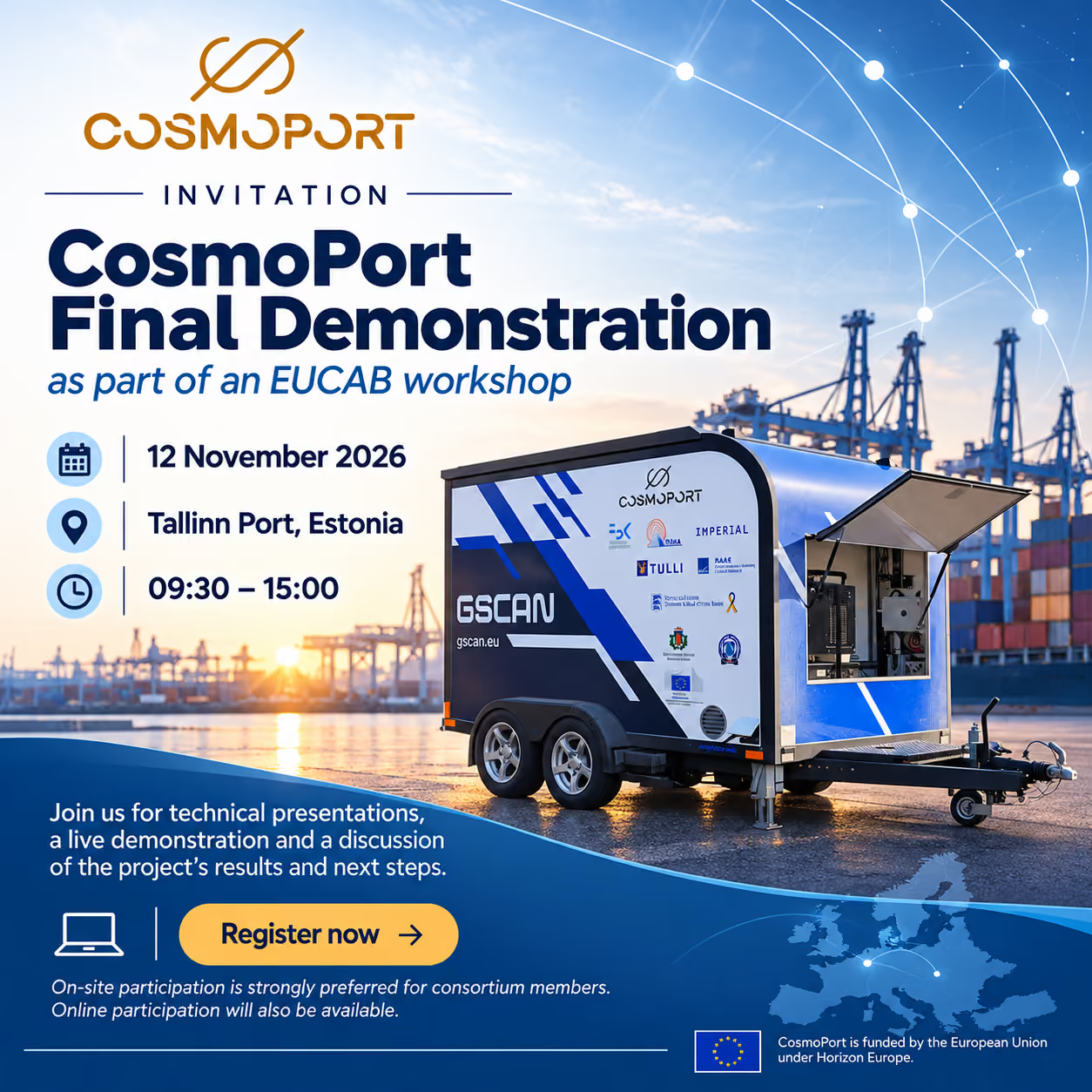
CosmoPort Final Demonstration
The programme will present the project’s mobile atmospheric-ray tomography system through technical talks, related European initiatives and a live demonstration, followed by discussion of the results and next steps.
On-site participation is strongly preferred for consortium members and offers the best opportunity to see the system and meet the experts. Online participation will be available for other interested guests.


The most notable R&D achievements:
• Mobile MTT device with an adjustable height to accommodate object with different heights.
• Improvement in AI based reconstruction, tomography & material classification algorithms.
• Developent and produce the cost-optimised Data Acquisition (DAQ) system.
• Differentiating different material classes.
• Mobile system specific calibration algorithms.
• TSV (through-silicon-via) SiPM development.

The system has been already demonstrated to the Estonian and Finnish customs in March 2026 with demonstration in Greece coming up in September and final public demo taking place in late Autumn of 2026.
Keep up to date on our LinkedIn page!
• Muon transmission tomography, or ART-systems, offers a unique blend of 3D imaging with atomic composition data, a capability that traditional X-rays lack.
• They utilize autonomous decision-making through machine learning, reducing the need for human interpretation, and are cloud-ready for seamless integration with the IoT.
• ART-based technologies are highly scalable, allowing for versatile applications limited only by creativity.
• With no artificial radiation source, these systems are radiation-free and easily modifiable, enabling novel uses such as mobile solutions.
• They also significantly reduce operating costs due to extended lifespan, reduced power consumption, and absence of radiation-related regulations or equipment needs.
• Safe to operate.

DetectionHub is a collaborative initiative bringing together EU-funded projects focused on detecting drugs, explosives and other illicit goods. Led by the Center for Security Studies (KEMEA), the hub promotes knowledge exchange and cooperation between research projects, technology developers and law enforcement stakeholders, helping connect innovative detection technologies with the needs of police, customs and other security authorities.
Through joint workshops, coordinated communication and stakeholder engagement, DetectionHub enables participating projects to share findings, identify common priorities and explore opportunities for the practical application of their results. CosmoPort is part of this network and has co-organised its workshop activities, contributing to the exchange of expertise and the development of synergies across Europe’s detection and security research community.
LinkedIn: https://www.linkedin.com/company/detection-hub

ARMADILLO is an EU-funded project developing innovative forensic solutions for the rapid and reliable detection of Gamma-Hydroxybutyrate (GHB) in urine, saliva, and beverages. The project combines portable on-site detection devices with AI, spectroscopy, secure forensic data management, and data-driven risk analysis to support law enforcement agencies in both the investigation and prevention of GHB-related drug-facilitated crimes.
ARMADILLO’s solutions are being validated through three real-world use cases covering GHB detection in bodily fluids in Poland, beverage testing in Spain, and AI-supported risk-based crime prevention in Finland. Alongside technology development and validation, the project also supports knowledge sharing, training, research collaboration, and the development of policy and security strategies addressing drug-facilitated crime.
ARMADILLO is co-funded by the European Union’s Horizon Europe Research and Innovation Programme under Grant Agreement No. 101168416.
LinkedIn: https://www.linkedin.com/company/armadillo-eu-project
CEASEFIRE was an EU-funded project that developed AI-powered solutions to support law enforcement agencies in detecting, analysing and tracking illicit firearms trafficking. The project combined online intelligence gathering, computer vision, cryptocurrency analysis and information-sharing tools to support investigations across both digital and physical channels and strengthen cooperation between authorities.
CEASEFIRE’s technologies were tested through pilots in Portugal, Serbia, France and Poland. Its five use cases addressed firearms intelligence sharing, on-site identification and registration of seized firearms, dark web investigations, X-ray screening of postal and courier parcels, and the online circulation of blueprints for 3D-printed firearms. Alongside technology development, the project supported practitioner training and work to strengthen National Firearms Focal Points and cross-border information exchange.
CEASEFIRE ran from 1 October 2022 to 30 September 2025 and received funding from the European Union’s Horizon Europe Research and Innovation Programme under Grant Agreement No. 101073876.
LinkedIn: https://www.linkedin.com/company/ceasefireproject
Airport passenger security and random cargo checks
Random security checks at airports have become increasingly essential in the face of evolving threats to aviation safety. Muon transmission tomography, with its capacity to provide highly detailed images of luggage and cargo, offers a crucial tool for enhancing airport security. By conducting non-intrusive scans of checked and carry-on baggage, this technology enables authorities to detect hidden items of concern, such as explosives or weapons, while minimizing the inconvenience to passengers. It not only improves security but also helps maintain the smooth operation of airports, reducing delays and enhancing overall passenger experience.


Logistic centres of smaller courier companies
Muon transmission tomography holds great potential in optimizing security measures within logistic centers of smaller courier companies. This advanced imaging technology offers a non-invasive solution for screening packages and cargo, allowing for the detection of concealed contraband, hazardous materials, or threats without the need for physical inspection. By implementing muon tomography, smaller courier companies can enhance their security protocols, streamline cargo screening processes, and significantly reduce the risk of potential security breaches. This technology not only bolsters security but also ensures the efficient flow of goods, contributing to the overall success of these courier companies.

Small-scale maritime cargo checks
The security of yacht harbors is a priority, given the potential for maritime environments to be exploited for illicit activities. Muon transmission tomography can play a pivotal role in ensuring the safety and security of these harbors. By conducting non-invasive scans of vessels, this technology can identify potential security risks, such as hidden contraband or concealed weapons, promoting a safer maritime environment. By implementing such advanced imaging systems, authorities can effectively deter illegal activities and ensure the protection of both yacht owners and the surrounding community.

Optimization of the usage of stationary x-ray system
Certain concealed materials, including those wrapped in dense substances like lead, foil, and plastic, remain undetectable by conventional X-ray scanning systems. This limitation underscores the need for more advanced imaging technologies, such as muon transmission tomography, which could potentially surpass X-ray measurements. Muon transmission tomography offers the advantage of providing highly detailed 3D images of objects, rendering it a promising solution for security and inspection purposes. The technology's ability to penetrate dense materials could significantly enhance detection capabilities, making it a valuable asset in security operations where traditional X-ray systems fall short.

Let's answer some FAQ's
Let us know if you want to talk about CosmoPort!

Privacy is important to us, so you have the option of disabling certain types of storage that may not be necessary for the basic functioning of the website. Blocking categories may impact your experience on the website. More information

